


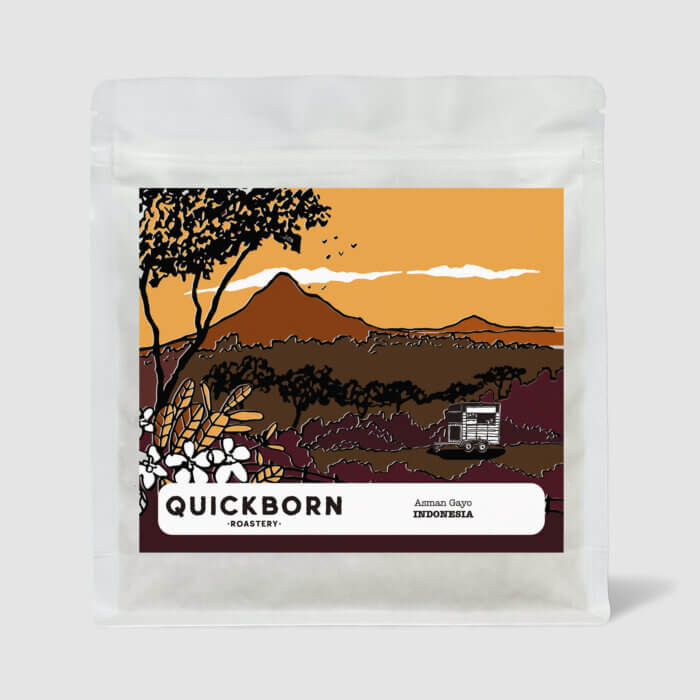
Indonesia
Detailed product description
This coffee comes from a small mill in the Pegasing district of Takengon, located in Aceh, one of Sumatra’s most renowned coffee-growing regions. The mill is operated by Cup of Excellence winner Asman Arianto and serves several smallholder coffee producers from the villages of Pantan Musara.
Aceh Region
Aceh, in northern Sumatra, is one of Indonesia’s most remarkable coffee-producing regions. The average farm covers just one hectare, around 80% of coffee growers in northern Sumatra are women, and approximately 95% are smallholder farmers.
The region is geographically diverse, with coastal plains and wetlands giving way to the Barisan Mountain Range, which stretches across the island’s interior. Coffee is cultivated on the fertile volcanic slopes surrounded by lush rainforest. One of the region’s most notable landmarks is Lake Toba, the world’s largest volcanic lake.
Sumatra
Sumatran coffees have long been recognised for their earthy, savoury, herbal, and sometimes vegetal flavour profile. These characteristics are influenced by the region’s climate, the varieties grown, and, most importantly, the distinctive post-harvest processing method known as wet-hulling, or Giling Basah in the local language.
Before the 1970s, coffee in Sumatra was primarily processed using the two most common methods found around the world: washed and natural. During the 1970s, growing demand from Japanese buyers encouraged the adoption of the wet-hulling process. This unique drying and milling technique is largely responsible for the unmistakable flavour profile of Sumatran coffees, as well as their characteristic bluish-green appearance in the green bean.
Wet-hulling was developed specifically to speed up the drying process and improve efficiency in Sumatra’s humid tropical climate, where frequent rainfall and heavy cloud cover make conventional drying difficult. By removing the parchment layer while the coffee still contains a relatively high moisture content, the beans dry much more quickly on patios or tarpaulins, even under challenging weather conditions.
Processing
Natural coffees are typically processed on the same day they are harvested. First, the cherries are sorted according to ripeness and quality, then rinsed to remove dirt and impurities. At many processing stations, this initial sorting is carried out using a flotation tank: damaged or defective cherries float to the surface and are removed, while the dense, high-quality cherries sink to the bottom before being cleaned.
The sorted cherries are then spread onto raised drying beds, tables, tarpaulins, or patios, where they are turned regularly throughout the drying process to ensure even moisture loss. Depending on weather conditions, drying typically takes between 30 and 40 days.
V60 Recipe
-
Brew ratio: 1:15
-
20 g coffee
-
Grind: 24 clicks (Comandante)
-
Brew time: 2:40
-
Water profile: GH 5, KH 3, 94 °C
Method:
Pour 60 g of water over 20 g of coffee and let it bloom for 40 seconds.
Slowly pour another 120 g of water in circular motions.
When the previous pour has almost drained, add the final 120 g of water — again slowly and in circles.
Total extraction time should be around 2:40.
Don’t hesitate to experiment — adjust the grind (if bitter notes dominate, go coarser; if the cup tastes flat or watery, go finer) or play with the brew ratio.